SEO · Case study
A domain with no history to paid bookings in under 30 days
A new airport and cruise port transport company in South Florida started with a domain that had never existed: no history, no reviews, no Google Business Profile. The first customer tapped WhatsApp on day one. The first bookings landed on day 20, three of them in a single day, and the first deposit was paid online on day 26. By week nine the back end held 13 bookings, the site had logged 15 taps on call or WhatsApp, and it had earned 6,231 search impressions across 81 pages. Every deposit paid online came from someone who arrived through organic search.
Starting from nothing
Most SEO case studies begin with a site that already ranks. This one began with a domain that had never existed.
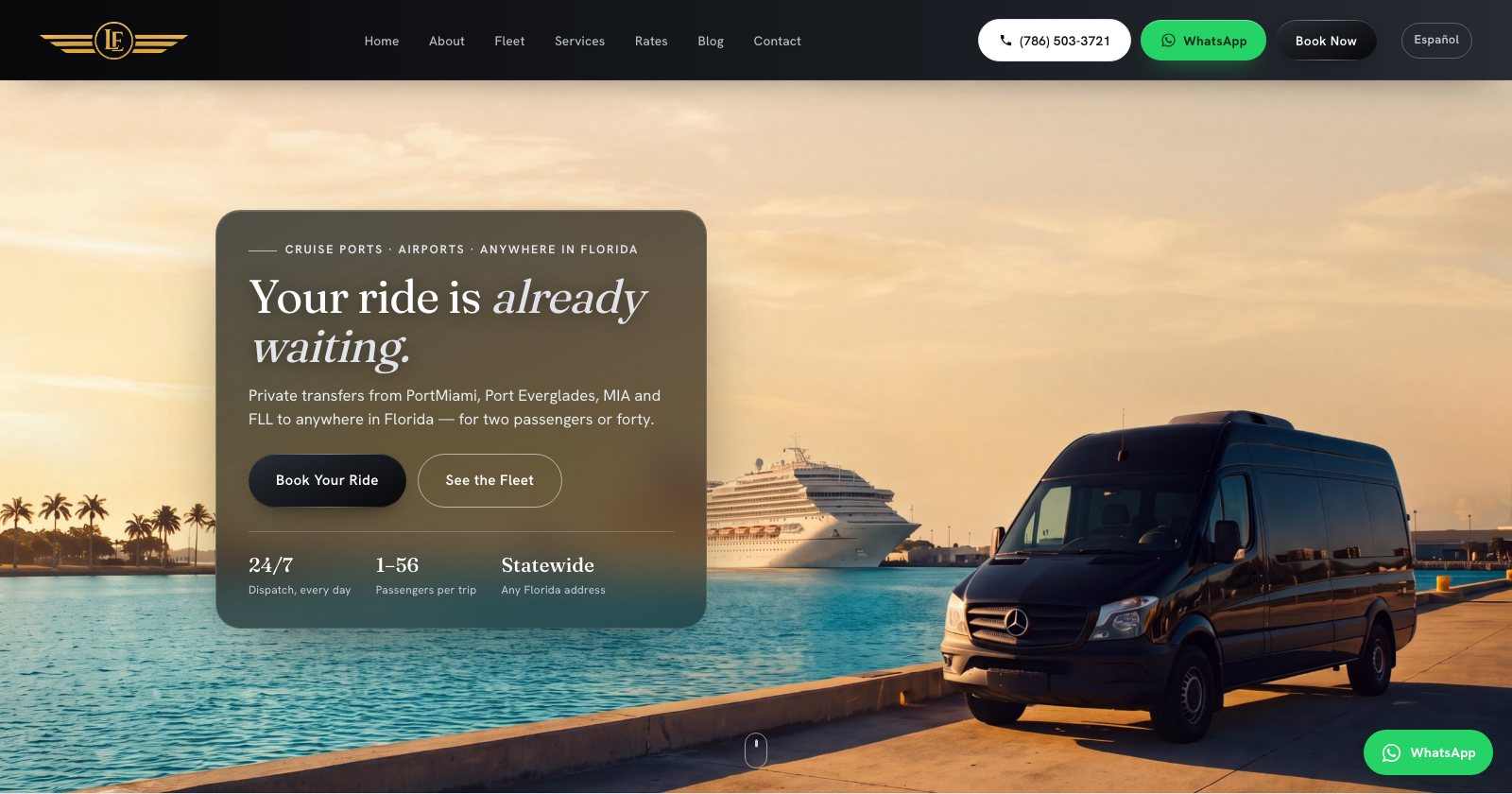
The client drives people between Miami and Fort Lauderdale airports and the cruise ports. In August 2026 the business had no website, no search history, no reviews and no Google Business Profile. Its competitors had all three, and most had a decade of head start.
The business is simple and the market is not. People land at MIA or FLL, they have a ship to catch, and before they book anything they want one thing: the price. The established competitors answer that badly. Several publish their rates as a photograph of a price list, which no search engine and no AI assistant can read. Others make you fill in a form and wait.
That gap is the entire strategy.
What we built
92 pages, English and Spanish, generated from one build so every page carries the same structure, schema and internal linking without being maintained by hand.
The pages are organised the way customers actually search:
- A page per route, like Fort Lauderdale airport to Port of Miami, with the real fare on it
- A page per cruise terminal, including which ships use it
- A page per service area
- A rates page carrying the full price table as real HTML
- Guides for what people ask before booking, like how much time to leave between a cruise and a flight
Every price is published as text in a table, never an image. The same table is published again as a plain text file and referenced from an llms.txt, so an assistant reading the site quotes the fare correctly instead of guessing. Structured data marks up the offers, the questions and the business itself.
Spanish is not an afterthought here. South Florida is bilingual, and the Spanish rates page turned out to be the second most used entry point from search.
Then the part most transport sites skip: we let people actually book. The site prices the trip on the server from the published table, takes a deposit through PayPal and sends the owner the booking. No phone tag, no quote form disappearing into an inbox.
What happened in nine weeks
Search Console, 6 August to 7 October 2026.
| Measure | First 28 days | Most recent 28 days |
|---|---|---|
| Impressions | 3,531 | 2,161 |
| Clicks | 15 | 16 |
| Average position | 50.5 | 20.8 |
| Impressions, whole window | 6,231 across 81 of 92 pages | |
Analytics for the same window records 501 sessions from 348 people. The channels that produced enquiries, and what each one produced:
| Channel | Sessions | Enquiries recorded | Deposits paid online |
|---|---|---|---|
| Organic search | 72 | 2 | 3 |
| AI assistant (ChatGPT) | 19 | 8 | 0 |
| Direct | 165 | 2 | 0 |
The speed matters as much as the totals. A customer tapped WhatsApp on the first day the site was live. The first three bookings arrived together on day 20, before the business had a single review or a Google Business Profile, and the first deposit was paid online on day 26. Everything after that was the pages climbing and the volume following.
Thirteen bookings is the number the owner can count in his dashboard, and it is the conservative one. The site also logged 15 taps on call or WhatsApp, each of them a customer starting a conversation the website never sees the end of. Those are real enquiries that we deliberately do not claim as bookings. Thirteen is the floor.
Three things here are worth sitting with.
The channel that booked trips was not the biggest one. Organic search brought 72 sessions, a fraction of the site's total traffic, and produced every deposit paid online. Volume and revenue are not the same measurement, and a new site is better judged by the second one.
The smallest channel produced the most enquiries. Nineteen visits arrived from ChatGPT and eight of them submitted a booking. That is two thirds of every recorded enquiry, from four percent of the traffic. Someone who asks an assistant for a cruise port transfer and gets sent to you arrives having already decided.
Average position halved, from 50.5 to 20.8. On a domain with no history that is the whole site moving from page five to the bottom of page two.
And the trajectory is the point. A domain that did not exist in July was ranking on the second page across its whole catalogue by October, on queries its competitors have spent years holding. Position came first, and clicks follow position.
Why it worked
First bookings inside three weeks, first online deposit inside a month, 13 bookings and 15 direct contacts by week nine, from a business that did not exist on the internet in July. Four decisions did most of that work.
We published the prices. Competitors hide their rates behind a form or post them as a photograph of a price list. Every fare on this site is text, in a table, on the page that ranks for that route. The customer who wants an answer now goes to whoever gives it, and that is the customer who books.
We built it to be quoted. The rate table is published again as plain text and referenced from an llms.txt, and every page carries structured data for its offers and its questions. That is why ChatGPT sends this business customers: an assistant can read the fares, trust them, and pass them on. Two thirds of the site's recorded enquiries came through that door.
We let people book on the page. The site prices the trip from the published table, takes a deposit through PayPal and books it. Three customers paid without a phone call, a quote form or a wait, and fifteen more started a conversation on the buttons next to it.
We built it bilingual from the first page. South Florida searches in Spanish, and the Spanish rates page became the second most used entry point on the site. Most competitors translate late, or never.
And there is more coming. This business is ranking before it has a single review or a Google Business Profile, the two strongest signals a local service company can hold. Both are in progress, and the pages they will lift are already built and already indexed.
Questions people ask us about this
How long does SEO take for a brand new website?
Faster than most people expect. This site went live on 6 August 2026, took its first customer contact on day one, its first three bookings on day 20 and its first deposit paid online on day 26, reaching 13 bookings and 15 direct call or WhatsApp contacts by week nine. Average ranking position improved from 50.5 in the first four weeks to 20.8 in the most recent four, which is a new domain moving onto page two across its whole catalogue. Clicks follow position, so they build after the rankings do.
Should a service business publish its prices on its website?
Yes, as text. On this site every fare is published in an HTML table, repeated as a plain text file and referenced from an llms.txt. Competitors who published rates as photographs of a price list cannot be read by search engines or AI assistants. Every deposit paid on this site came from someone who read a published price and paid without speaking to anyone first.
Do AI assistants send real traffic to small business websites?
They do, and it converts. Nineteen sessions arrived from ChatGPT in nine weeks and eight of them submitted a booking, two thirds of every enquiry the site recorded, from four percent of its traffic. That is a higher conversion rate than any other channel on the site. Assistants quote text, so a site written to be read cleanly as text is what makes that possible.
How do you make a website that AI assistants will recommend?
Write it so it can be quoted. On this site the fares live in HTML tables rather than images, the same table is published again as a plain text file referenced from an llms.txt, every page carries structured data for its offers and questions, and the copy answers the questions customers actually ask. An assistant can only recommend what it can read and verify.
If you sell a service with a price
If your competitors publish nothing and still outrank you, that is the gap we build into. We will look at your market and tell you what we find, whether or not it turns into work.
Talk to us about your search traffic